
Midterm Predictions: Strategies and Technologies Shaping the 2026 Elections
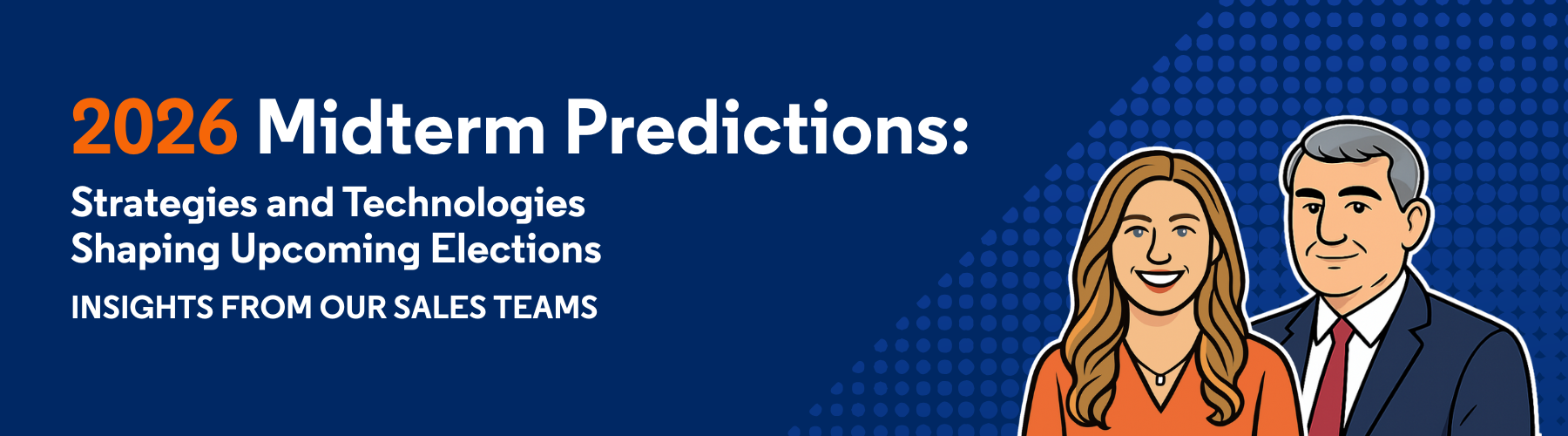
The past couple of years — 2024 and 2025 — have been rather unprecedented in the political world. Not only have we seen major shifts in politics, but the way we connect with voters has changed, too. To kick off the year, we sat down with our Republican and Democratic team leaders to get their thoughts and predictions on which ideas or technologies will shape the 2026 elections.
McKinley Williamson: Let’s start by asking, what strategies or trends do you believe will be game-changers for engaging voters in 2026?
Donna Ra’anan-Lerner: It might sound like a no-brainer, but I believe that a key aspect of this cycle will be ensuring that, when campaigns talk to voters, their messages are as specific as possible. The data shows that the more specific a creative is to an individual voter, the more likely it is to persuade them.
We often discuss multicultural voter outreach in our client meetings, recognizing that not every person of color will respond to a candidate’s message — or an issue — in the same way. It’s vital that the creative aligns with the individual audience, not just in language but also in the message we’re delivering. I think these midterms will prove the importance of avoiding broad-stroke messaging for each voting group.
Joel Sawyer: Just to dovetail on that, it’s obvious and maybe a bit cliché that AI is going to play a huge role in this cycle, particularly on the creative side. Time is the only truly limited resource in a campaign; that’s why we advertise in the first place. A candidate can’t go door-to-door to convince every voter. So, leveraging that time via paid media is essential. AI will allow candidates to customize messages to various voting segments more efficiently.
However, there’s a saying: Just because you have the tool doesn’t mean you should use it. I’m sure we’ll see AI deployed in many ineffective ways, but the campaigns that excel will be the ones that use it smartly to communicate with key voting blocs.
Donna Ra’anan-Lerner: Totally agree, Joel. This point is particularly true when discussing emerging platforms, whether they’re gaming, social media, or audio. It’s important for campaigns to be very specific with their ad environments. AI provides a powerful tool for just that — creating multiple versions of ad creatives and learning and adapting strategies on the fly.
Joel Sawyer: AI also amplifies our ability to do something we’ve been doing for years in digital targeting — using device graphs and set-top box data to drill down on the audiences we want to reach.
Donna Ra’anan-Lerner: Yes, absolutely! At Optimum Media, everything we do is backed by our first-party access to household data from set-top boxes and IP addresses. This gives us a unique edge in planning and executing our campaigns while keeping a constant feedback loop. We’re always learning and adapting. Measuring CTV can be tough since it’s a non-clickable environment, so we don’t have many chances to analyze user engagement on a deeper level. Last year, our in-house data science team looked into the relationship between reach, frequency, and ad spend to figure out if reaching voters more often actually persuades them. As expected based on the industry standard, we found that about seven impressions per week were the sweet spot for the most effective use of campaign budgets, as well as the highest recall and persuasion. The truly compelling part of the study was how the ad recall and persuasion varied by demographic groups. The important part here is focusing on marrying the creative exposure at the optimal frequency with the persuadability of each specific audience.
Deeper insights like these will become more important and actionable as we’re able to target audiences in more specific ways - not just with creative but also in terms of frequency. Because of this, I’d expect to see an increased focus on reach and frequency this cycle, now that the industry standards are bolstered by our in-house research as well. By digging into these metrics and partnering with trusted sources for reliable insights, we can ensure we effectively reach virtually every single voter.
Joel Sawyer: Absolutely, Donna. You bring up a great point. When we discuss reaching as many voters as possible, we often think about audience-targeted CTV, focusing on specific demographics or voting histories, which we’ve been doing in digital for years.
While the reach of audience-targeted digital has improved significantly, it will never be 100%. We need to analyze the insights from the people we’re actually reaching in that targeted environment. We should ask ourselves: What are these voters watching? How are they engaging online? What platforms do they use most?
For example, we can pull data from set-top boxes to see how we can target them differently on CTV. This helps ensure more of our target audience receives the message instead of those who fall within our initial audience pool.
Donna Ra’anan-Lerner: The lesson we keep learning here is how to balance precision targeting with broad reach best. Especially on the left, we have a strong tendency for one-to-one voter targeting. While this approach is effective, we also risk leaving many voters untouched.
Whether it’s their overall media allocation or digital audience strategy, campaigns must strike the right balance between hyper-targeting and ensuring we reach voters wherever they are. This means keeping up with emerging platforms and evolving media habits, and learning from the data each cycle.
Joel Sawyer: Right, you raise another good point there, Donna. We’ve had many conversations on the right as well, considering the trade-offs between waste and incrementality. Sometimes, the answer is to accept that we may hit people outside our target audiences to increase overall message penetration in key demos.
Donna Ra’anan-Lerner: Definitely, and it’s important to know how you identify each voter. Are you working with partners who can effectively scale across platforms? Are you prioritizing your first-party list and reaching them across diverse inventory sources?
Reaching 100% of your audience on a single platform is unlikely, so it’s essential to maintain a diversified media mix that effectively reaches voters across different screens.
McKinley Williamson: Building on what you just said, Donna, regarding cross-screen optimization, for 2026, what do you think will be key platforms or content verticals?
Donna Ra’anan-Lerner: Well, this isn’t anything new, but I’ve been advocating for podcasting for years! Post-pandemic, the ubiquity of podcasts has changed the game. Campaigns have historically struggled to reach audiences through podcast advertising. Back in the day, you had to rely on individual podcast hosts, which significantly limited your reach and took too much manual effort.
Now, the landscape is evolving, offering better ways to buy podcast ads. Audiences are tuning in to podcasts more than ever — the average American listens weekly — creating a vital audience that campaigns cannot afford to overlook. The 2024 Trump campaign leveraged this to its advantage by engaging podcast creators, which is a learning moment for our industry at large. I think podcast investment will continue to increase, especially with programmatic buying and dynamic ad insertion, making it easier to reach that highly engaged audience.
Joel Sawyer: Absolutely, and along those same lines, there’s been an increased focus on reaching audiences through live sports streaming. Many people who had kept traditional cable subscriptions had largely kept them for live sports, even when they were consuming most content via streaming. As the number of options for watching live sports via streaming has increased, more people are ditching cable entirely and consuming media exclusively via streaming. So in that way, live sports were kind of the final frontier in CTV advertising.
Now that those live sports are available through streaming, their popularity has surged. We first noticed this trend two cycles ago, and it exploded in the 2024 cycle. I expect it will be huge again this year. In 2026, I’ve found that campaigns have become more savvy about live sports advertising. Early on, anything labeled “live sports” sold instantly, even if it was sports-adjacent content or sub-premium sporting events. But buyers quickly realized they weren’t getting what they thought they were, which pushed transparency to the forefront. At Optimum Media, we now provide event-level reporting for live sports across many leagues, frequency tracking, and consolidated reach to give better insights. This level of transparency and measurement wasn’t available to many campaigns and agencies before.
Donna Ra’anan-Lerner: Exactly! You can’t beat the time spent, and the enthusiasm sports fans have for their teams. Live sports offer a unique opportunity for campaigns to connect with engaged audiences. And thankfully, our industry is finally able to scale and measure these platforms effectively ahead of this year’s midterms.
Joel Sawyer: We’re already seeing significant reservations about live sports for the fall. This will be a major focus in reaching voters, given the high engagement rates.
Donna Ra’anan-Lerner: Absolutely. We’re approaching a point where we can efficiently measure the effectiveness and scale of both podcasting and live sports. I expect to see much higher investment from political campaigns in both areas this cycle.
McKinley Williamson: To wrap it up, what’s your bottom line?
Donna Ra’anan-Lerner: I don’t have a crystal ball, but what’s clear is that trends in platform usage, cross-device measurement, efficiency, and scale aren’t going anywhere. These will continue to be top priorities, and we can expect to see a lot of progress this cycle. 2026 will be a year of maturity and sophistication in digital ad buying.
Joel Sawyer: *laughs* Just over here thinking about maturity and sophistication in modern politics… But yes, I agree, Donna, the tools for efficiency we’ve discussed will enable us to better align targeting precision with creative strategies. So maybe 2026 will be the first time we can match the precision and efficiency we’ve achieved on the ad tech side with the creative side. Meaning it could make those responsible for delivering the right messages to the right audiences busier than ever before.
McKinley Williamson: Great note to end on! Thank you, Donna and Joel, for your time.
Donna Ra’anan-Lerner currently serves as Director of our Democratic Politics & Public Affairs team at Optimum Media.
As Senior GOP Account Executive, Joel Sawyer leads the Republican Politics & Public Affairs team at Optimum Media.
McKinley Williamson is the Strategic Partnership Director for Politics and Public Affairs at Optimum Media, where she develops and executes initiatives to craft compelling brand storytelling, drive revenue growth, and seize market opportunities across the Politics & Public Affairs vertical.