
After the 2024 election, Optimum Media's Data and Analytics team set out to look more deeply into a key campaign metric for political ads: how many CTV ad exposures are required to make outreach both efficient and effective?
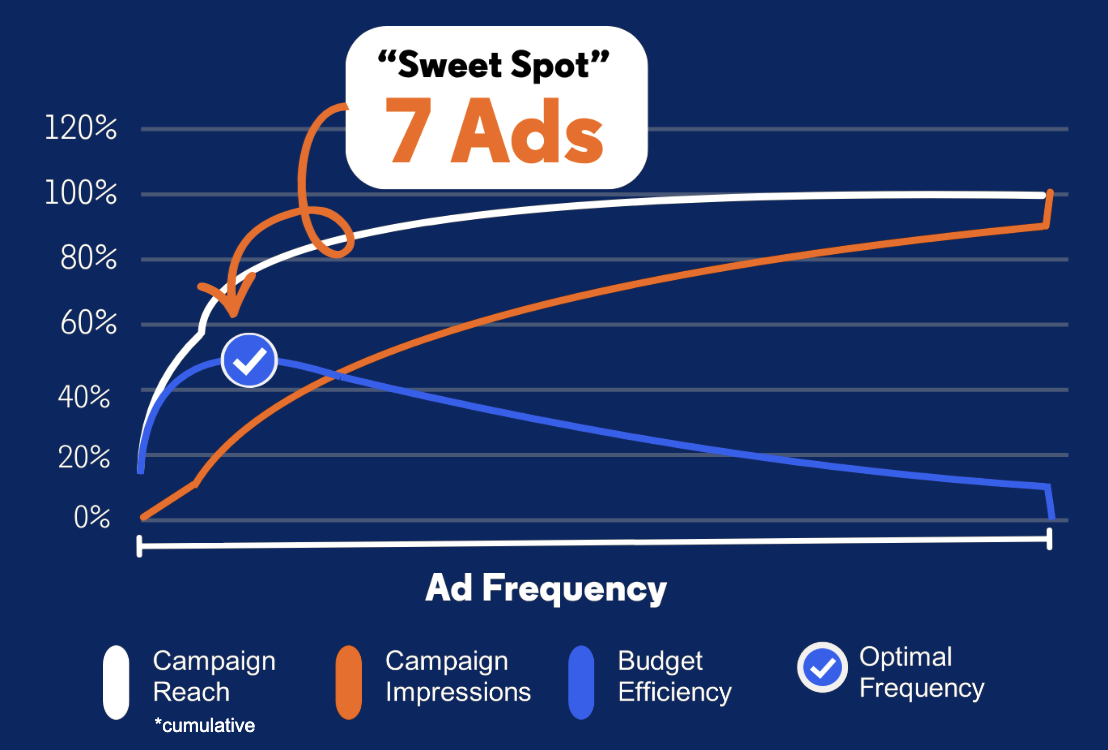
Our data scientists analyzed 83 campaigns across the political spectrum at the IP level to identify the weekly frequency "sweet spot" where budget efficiency and incremental reach remained positively correlated. By calculating the rate at which advertising spend outpaced cumulative reach growth, the team determined spend-per-reach and identified seven times per week as the optimal frequency for political CTV, balancing voter reach with budget efficiency. They also found that higher frequency (>7x/week), while producing extra impressions, does not meaningfully expand weekly reach, suggesting campaigns should maintain the optimal cadence while exploring other tactics to broaden reach without overspending.
To validate those findings in a live election, Optimum Media partnered with DGA (Democratic Governors’ Association) and GMMB to run a research study testing the impact of ad frequency during the 2025 New Jersey gubernatorial race. To explore this, we conducted a brand lift study to assess how advertising exposure affects key metrics such as awareness, recall, and behavioral intent. Using AdMessenger, our proprietary mobile ad solution, we evaluated the data through frequency breakdowns by running a survey that compared voters based on their recent ad exposure within a rolling seven-day window (between 9/10/2025 -11/05/2025), segmenting them into an Optimal Frequency group (<7x/week) and a High Frequency group (>7x/week).
To measure differences across those frequency groups, our data team retargeted New Jersey voters who had seen the DGA CTV ads and surveyed them on ad recall, voting intent, and decisiveness. The goal was to determine whether the most efficient ad frequency also delivered the largest effect on voter behavior.
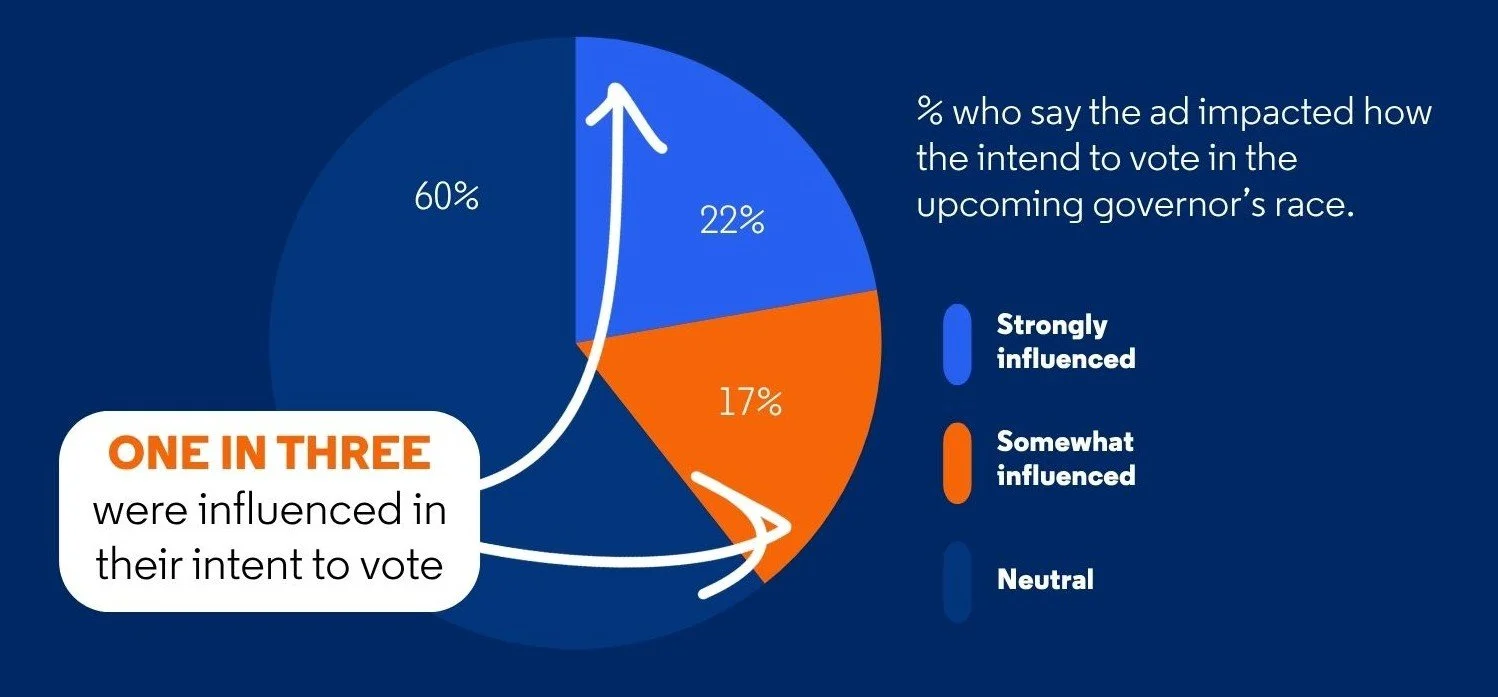
Overall, the Optimal Frequency group produced stronger persuasion and greater decisiveness. The voters exposed within the optimal range were more likely to move from undecided to decided, and to report that the ad meaningfully influenced their view. By contrast, raising the frequency didn't actually boost persuasion. Instead, it often meant similar recall but less change in voter preference and more voters remaining undecided.
Ryan Olson, vice president and digital media supervisor at GMMB, reflected on the campaign's results: "The study validated our working hypothesis that the optimal frequency isn't simply about maximizing ad impressions, but about finding that crucial sweet spot where message resonance peaks. We observed that voters who received ads within our identified optimal range demonstrated not just higher recall, but more decisive movement from undecided to committed. This reinforces that effective political advertising isn't about bombarding voters—it's about strategic, well-calibrated exposure that respects both budget constraints and voter psychology."
The study also revealed important demographic variations. Gen X voters (ages 45–54) recalled and responded better under the Optimal Frequency, suggesting fewer, well-timed impressions work best for this cohort. Asian, Hispanic, and lower-income respondents demonstrated higher recall with heavier exposure, though higher recall did not always translate into greater persuasion. Democrats, white voters, middle-income households, and younger adults (ages 18–24) showed similar recall rates across frequency levels, indicating these groups can be reached effectively without oversaturation.
Party affiliation also shaped outcomes. Higher-frequency ad exposure amplified ad impact among both Democratic and Republican voters, while independents and multiparty voters showed less responsiveness to increased exposure.
The core implication is that there is a "sweet spot" for impressions where recall, persuasion, and decisiveness align. Campaigns that cap exposure near the optimal range achieve greater persuasion per impression and a better return on ad spend. Pushing beyond the "sweet spot" tends to increase awareness but yields diminishing returns in the outcomes that matter most: converting undecided voters and solidifying turnout.
For future campaigns, rigorous testing is essential, as noted by Olson, "Digital media planning should consistently incorporate rigorous testing to validate assumptions around optimal media weights and frequency levels. This test not only reaffirmed alignment with our established persuasion frequency models but also underscored the importance of tailoring optimal frequency strategies to different demographic audiences rather than treating them as a one-size-fits-all approach for future campaigns."
This strategic study and its measurable results earned our team industry recognition with a prestigious Reed Award for excellence in political CTV campaigning. In a political landscape where more impressions are often mistaken for greater impact, these studies highlight how Optimum Media's proprietary data, advanced targeting, and data-driven approach go beyond impressions to drive real voter impact.
Reach out to discuss how partnering with Optimum Media can turn data into a winning strategy.